Relocating to Houston for Work: Career & Housing Guide

Relocating to Houston for work? Match your job hub to the right neighborhood, plan your move timeline, and compare furnished vs. traditional housing.
Key Takeaways
- Pick your job hub before you look at a single listing. Houston's major employers sit in different corners of a very large metro.
- Houston has 27 Fortune 500 headquarters on the 2026 list, tied with Chicago for second among U.S. metros. The opportunity is broad; the right submarket is what saves you months.
- A furnished, flexible-term home lowers the cost of guessing wrong. You test the commute before a 12-month lease locks it in.
- Drive your commute at 8 a.m. and 5 p.m. before you sign anything. In Houston, miles tell you very little about drive time.
You Have a Start Date. You Don't Know Where to Live Yet.
Relocating to Houston for work usually starts the same way: an offer letter, a start date that feels too close, and a map of a metro that covers more than 600 square miles across three counties. There is no single downtown core the way there is in Chicago or Boston, so a listing that looks close to your office can sit on the wrong side of a freeway bottleneck.
Get it wrong and the cost is real. You lose hours a week on I-10 or the 610 Loop, you are stuck in a lease for a year, and you start a new job tired. Get it right and Houston's deep job market and zero state income tax work in your favor from the first paycheck.
The fix is doing the decisions in the right order. Work out which part of Houston's economy you are joining, let that narrow the neighborhoods, then use a flexible home base to confirm the commute before you commit. That is the order this guide follows.
At Sandpiper Homes, we place relocating professionals into fully furnished mid-term homes across Houston, and this is the sequence we walk new arrivals through every week.
Scouting Houston before you commit to a year? → Explore furnished Houston homes with Sandpiper Homes
Which Houston Industry Hub Matches Your Career?
Greater Houston is not one job market. It is several, each clustered in a different part of the metro, and the region now counts 27 Fortune 500 headquarters on the 2026 list. Matching your background to the right hub shortens your commute and your job search at the same time.
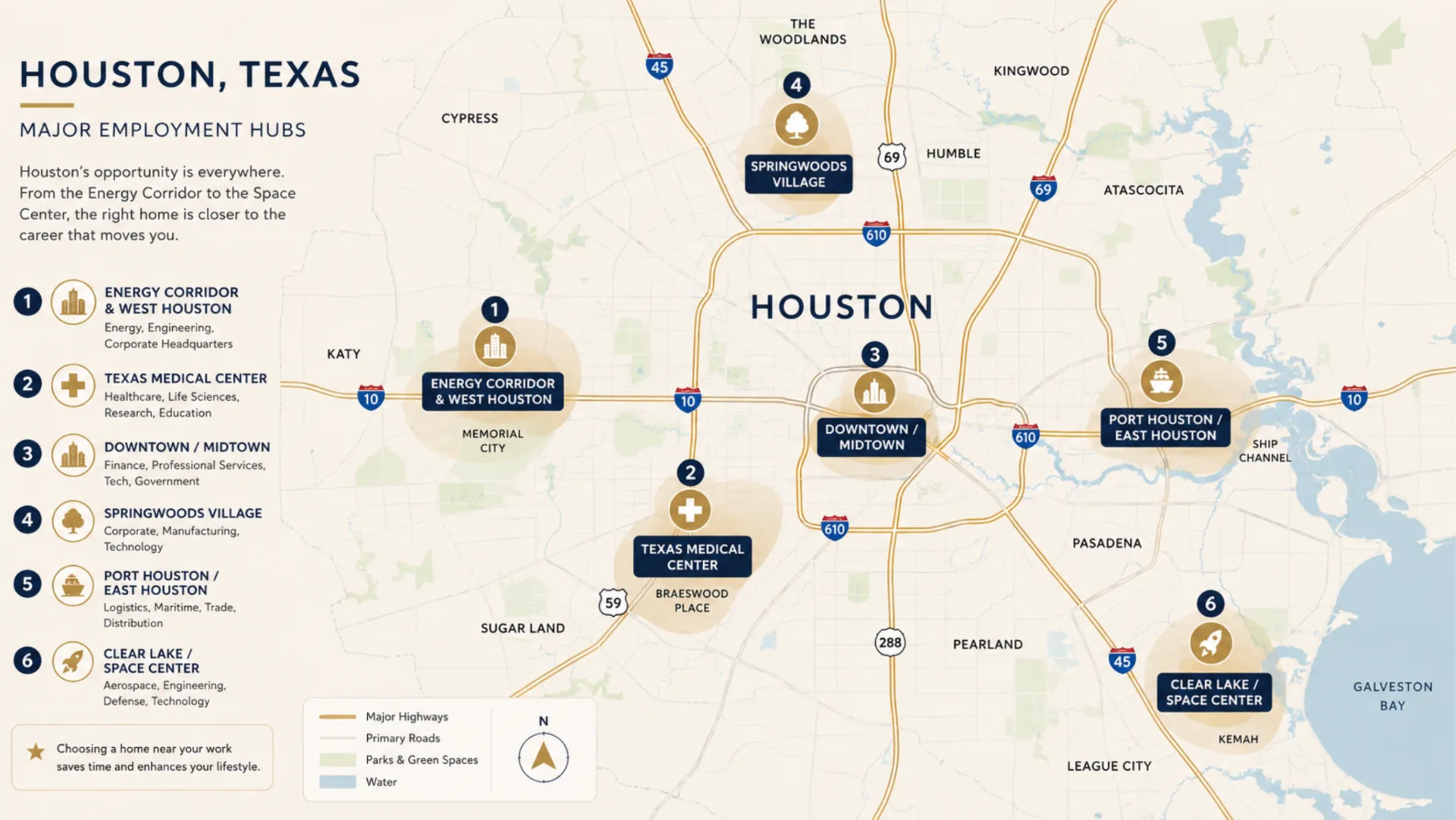
| Hub | Dominant industries | Anchor employers | Typical roles |
|---|---|---|---|
| Energy Corridor & West Houston | Oil and gas, renewables, clean tech | BP America (Westlake Park), ConocoPhillips, Citgo | Energy engineers, project managers, sustainability leads |
| Texas Medical Center | Clinical care, research, life sciences | MD Anderson, Houston Methodist, Memorial Hermann, Texas Children's | Physicians, nurses, researchers, healthcare administrators |
| Downtown & Midtown | Corporate finance, law, enterprise software | Chevron, JPMorgan Chase, Waste Management, Baker Botts | Financial analysts, attorneys, tech leads |
| Springwoods Village / North Houston | Integrated energy, corporate campuses | ExxonMobil (Spring campus) | Engineers and corporate staff |
| Port Houston & Pasadena | Maritime logistics, refining, petrochemicals | Port Houston, ship-channel refineries and chemical plants | Supply chain managers, chemical engineers |
| Clear Lake & Space Center | Aerospace, defense, autonomous systems | NASA Johnson Space Center and its contractors | Aerospace engineers, systems analysts |
A note on accuracy: headquarters move, and many relocation articles run on stale lists. ExxonMobil's corporate campus is in Spring, not the Energy Corridor. Chevron has moved its corporate headquarters to Houston and works from Downtown. If a company is central to your move, confirm the exact office address with your recruiter before you pick a neighborhood.
Energy Corridor & West Houston
If your work touches upstream oil and gas, LNG or the energy transition, the Energy Corridor along I-10 West is still the densest cluster of energy employers in the region, anchored by BP America's Westlake Park campus.
Texas Medical Center
For clinical care, healthcare administration, biotech or device development, nothing in Houston compares. The Texas Medical Center describes itself as the largest medical complex in the world, with more than 120,000 employees and about 54 million square feet of developed space.
Downtown & Midtown
Commercial finance, corporate law and enterprise software concentrate Downtown, with Midtown as the walkable residential spillover. This is the clearest path into senior roles at large public companies.
Springwoods Village, Port Houston and Clear Lake
These three hubs sit far from the core, which is exactly why they matter. ExxonMobil's Spring campus pulls toward The Woodlands, the ship channel pulls toward the east side, and NASA's Johnson Space Center pulls toward Clear Lake. Live near your hub and each is an easy commute; live across town and each is a long one.
How Should Your Job Location Shape Where You Live?
Career and housing are not two separate decisions. The first should drive the second. Most relocation guides skip this step, and it is the one that decides whether your commute is fifteen minutes or seventy-five.
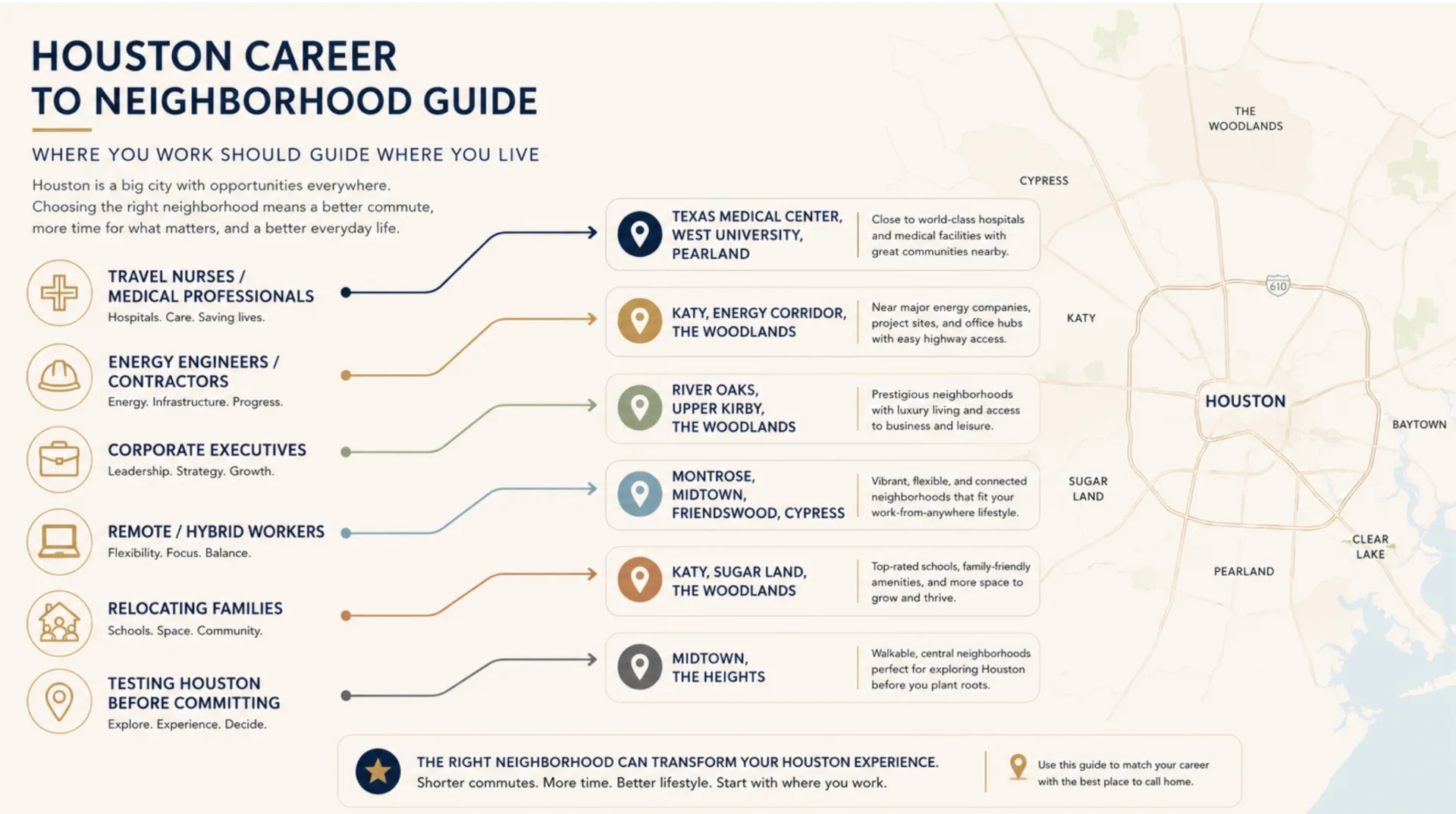
| If you work in… | Consider living in | Why |
|---|---|---|
| Energy Corridor | Energy Corridor itself, Katy, Cypress | Same-corridor access along I-10 avoids the worst cross-town congestion |
| Texas Medical Center | Med Center, West University Place, Museum District, Pearland | METRORail and walkable streets let clinical staff skip highway commuting on rotating shifts |
| Downtown / Midtown | Midtown, the Heights, Montrose | Red Line access and real walkability make these the most car-optional areas in the city |
| Springwoods Village / North | The Woodlands, Spring | Master-planned communities built around the same corporate campuses |
| Port Houston / Pasadena | Clear Lake, League City, Pasadena | Highway 225 and the Gulf Freeway get you there without crossing central Houston |
| Clear Lake / Space Center | Clear Lake, League City, Webster | Short local drives to NASA and contractor campuses |
| Remote or hybrid | Montrose, Midtown, the Heights, Friendswood | With no fixed commute, walkability and home-office space matter more |
For a street-level look at each of these areas, including what furnished homes rent for, see our neighborhood guide, Fully Furnished Apartments in Houston for Rent.
What Does Housing Near Each Job Hub Look Like?
Knowing the right hub is only useful if you know what living near it involves. Here is the realistic housing profile for each, the trade-off you accept, and how easy it is to find a furnished home while you settle.
| Job hub | Typical housing | Main trade-off | Furnished mid-term options |
|---|---|---|---|
| Energy Corridor | Newer garden-style apartments and townhomes, strong space per dollar | Car-dependent, little walkability | Widely available, driven by contractor and project cycles |
| Texas Medical Center | Mid- and high-rises, older West U rentals, Museum District condos | Smallest floor plans; parking often charged separately | Deepest furnished market in Houston, driven by travel nurses and residents |
| Downtown / Midtown | High-rises and converted Montrose low-rises | Highest cost per square foot inside the Loop | Good availability; best fit if you want to go car-free |
| Springwoods / North | Master-planned communities with resort amenities | I-45 is punishing if your office is actually Downtown | Available; tightest around corporate assignment cycles |
| Port Houston / Pasadena | Suburban single-family rentals and older apartments | Thinnest professional rental inventory in the metro | Limited; start searching early |
| Clear Lake / League City | Waterfront-adjacent apartments and family rentals | Long drive into central Houston if plans change | Moderate; coastal seasonality affects pricing |
We keep rent figures in one place so they never contradict each other. For current furnished rent ranges by neighborhood and suburb, use the comparison matrix in our Houston neighborhood guide.
How Do You Structure Your Relocation Timeline?
The right plan depends on your start date and who is moving with you, not a generic checklist. Three scenarios cover most people relocating to Houston for work.
Scenario A: The fast corporate move (under 45 days)
Your new role needs you in person within 30 to 45 days. Buying, or signing a 12-month lease in a neighborhood you have never driven, is the risky move here.
- Days 1 to 10: negotiate relocation benefits (packing, storage, a temporary housing stipend) and book a furnished, flexible-term home for the first 60 to 90 days.
- Days 11 to 25: confirm the home, put household goods into storage and set up mail forwarding.
- Days 26 to 45: arrive with luggage, start work, and use evenings and weekends to test-drive the neighborhoods on your shortlist.
On a very tight clock, our statewide guide, Texas Furnished Rentals: The 5-Day Fast Booking Playbook, walks through getting a verified furnished home booked in under a week.
Scenario B: The remote explorer (3 to 6 months)
You are hybrid or remote and can take time to learn Houston's submarkets before committing.
- Month 1: book a 30 to 60 day furnished home somewhere central. Midtown, the Heights and Montrose all reach the rest of the city easily.
- Months 2 to 3: drive your likely routes on I-10, US-59 / I-69 and the 610 Loop at 8 a.m. and 5 p.m. before assuming any of them work.
- Months 4 to 6: choose your long-term neighborhood and sign without time pressure.
Scenario C: The family-first move (school calendar)
You are moving with school-age children and want to keep academic disruption to a minimum.
- 3 to 6 months out: research the districts you are considering, such as Katy ISD, Fort Bend ISD or Cypress-Fairbanks ISD.
- 60 days out: reserve a furnished, pet-friendly home inside your target district boundary so enrollment is straightforward.
- 30 days out: complete enrollment, transfer records, and time the move for summer break so the kids settle before term starts.
Need a flexible home base while you decide? → Browse furnished Houston homes with Sandpiper Homes
Furnished or Traditional Housing: What Does Each Cost?
Once you know your target neighborhood, you still have to decide how to live there for the first stretch. The honest answer depends on how long you will stay and how sure you are about the area.
| Cost line | Furnished, flexible term | Traditional 12-month lease |
|---|---|---|
| Monthly rent | Higher: furniture, utilities and management are priced in | Lower baseline rent per square foot |
| Furniture & housewares | None | Bought or shipped, a large one-off outlay |
| Moving freight | Luggage only | Full household shipment, priced by distance and volume |
| Utility setup | Usually bundled, no connection deposits | Separate accounts and deposits per provider |
| Leaving early | Commonly 30 days' notice | Early termination penalties are standard |
| Time to move in | Days | Weeks after approval |
| Cost of being wrong | Low: you move at the end of the term | High: you absorb the penalty or the commute |
How to run the numbers for your own move
Price both options over the months you will actually be here, then divide by the number of months:
- Total rent for the period.
- Furniture and housewares, including delivery, or the cost of shipping what you own.
- Moving freight, quoted from your actual origin city.
- Utility deposits and setup fees for electricity, water, gas and internet.
- Early-termination exposure, if there is a realistic chance you move before the lease ends.
For shorter stays, furnished usually comes out ahead once furniture, freight and exit risk are counted, even with higher rent. For longer, settled stays in a neighborhood you already know, a traditional lease usually wins. Before you sign either, check the fees that sit on top of the listed rent in what a furnished apartment in Houston really costs.
This is the gap Sandpiper Homes is built to close: verified, move-in-ready Houston homes on flexible terms, so you are not choosing between an expensive hotel and a lease you are not ready for.
What Else Changes When You Become a Houston Resident?
Housing is the biggest decision, but it is not the only clock that starts when you arrive. Texas gives new residents 30 days to register a vehicle and 90 days to get a Texas driver's license, and Harris County adds an emissions test before registration. There is no state income tax, but property tax works differently here than almost anywhere else.
Frequently Asked Questions
What is the best way to start relocating to Houston for work?
Start with your job location, not the listings. Find out which hub your office sits in, shortlist two or three neighborhoods on the same side of the metro, then book a furnished home for 60 to 90 days. Drive the commute at rush hour before you sign anything longer.
Which Houston neighborhood is best for healthcare professionals?
The Texas Medical Center, West University Place and the Museum District are the strongest choices, because they allow walking or METRORail access to hospital campuses, which matters on rotating shifts. Pearland is a solid second option, with newer construction and a direct Highway 288 run into the Medical Center.
Where should I live if I work in the Energy Corridor?
Stay on the I-10 West side of the metro. The Energy Corridor itself, Katy and Cypress all give you short same-corridor commutes. Living inside the Loop and driving west each morning is possible, but you will spend much of the saved rent on time in traffic.
How does Houston's lack of zoning affect where I should live?
Houston has no traditional zoning, so a quiet street can sit beside a commercial strip or an industrial site. Neighborhood character can change block by block. That is the strongest argument for living somewhere for a few weeks before you buy or sign a long lease there.
How early should I book furnished housing before a work move?
For furnished mid-term homes, aim for 30 to 45 days before your start date. Inventory turns over monthly, so booking months ahead limits your choices, while waiting until the final week leaves very little, especially during the busy summer relocation season.
Should I rent or buy when I first move to Houston?
Rent first in almost every case. Houston's size, lack of zoning and neighborhood-by-neighborhood property tax differences make buying sight-unseen risky. A few months in a furnished rental lets you learn the commute and the area before you make a purchase you cannot easily undo.
Choosing Your Houston Base
Houston rewards people who make one decision before all the others: pick your job hub, then pick your neighborhood inside it. Square footage, school district, walkability and rent all become trades you make on purpose once that is set.
A furnished, flexible-term home is the practical way to make that decision properly. You live in the city, drive the real routes at rush hour, and sign a long-term lease knowing exactly what you are choosing.

Ready to land in Houston without the moving truck? → Browse furnished Houston homes with Sandpiper Homes
Looking for a furnished place?
Browse move-in-ready monthly rentals on Sandpiper.