
Best Areas to Live in Austin for Working Professionals.

Where to live in Austin depends on where you work. Match your job to the right neighborhood by commute, lifestyle and flexibility.
Best Areas to Live in Austin for Working Professionals: Match Your Neighborhood to Your Job
Search for the best areas to live in Austin and you get a list: Downtown, East Austin, Mueller, The Domain. The list is not wrong. It just answers a question you did not ask, because the best neighborhood for a downtown attorney is a poor one for a nurse on night shifts at a North Austin hospital.
Austin's work is spread across the whole region, and traffic makes distance expensive. TomTom measured a 40.5% average congestion level in Austin in 2025, with drivers losing 60 hours to rush hour across the year. A cheaper apartment on the wrong side of town can cost you that time every week.
This guide matches common types of work to the neighborhoods that suit them, then shows you how to test the choice before you sign a 12-month lease.
At Sandpiper Homes, we place relocating professionals into furnished homes across Austin. If you work in tech, see our dedicated guide to the best areas to live in Austin for tech workers .
Moving to Austin for work? → Browse furnished Austin homes with Sandpiper Homes
Why Your Job Location Should Decide Where You Live
The cost of a neighborhood is not just the rent. It is rent plus commute, parking, tolls, time and how easily you can change your mind.
Hybrid work does not remove that. TomTom's 2026 national report found Tuesday to Thursday became the dominant commute days in 2025, with Austin among the metros showing the sharpest midweek surges. "I only go in twice a week" usually means twice a week on the busiest days.
Paying more for location is rational when it removes a recurring cost: a second car, daily parking, tolls, or forty extra minutes in traffic each day.
Austin Neighborhood Comparison for Working Professionals
| Area | Best Suited To | Commute Advantage | Main Trade-off |
|---|---|---|---|
| Downtown | Corporate, finance, law, government | Walkable, with the easiest car-free living in the city | Premium rent; parking rarely included |
| North Burnet / The Domain | North Austin tech and corporate | Red Line and north-south access | Awkward for south or east-side jobs |
| Crestview / Allandale / North Loop | North-side workers wanting an established area | Reasonable run north while staying near the center | Less new housing; smaller units |
| Hyde Park / North University | Central hospital and university staff | Short trips to central hospitals and UT | Older buildings; limited parking |
| Mueller | Healthcare, hybrid workers, families | Central location with several routes into the core | Newer homes carry a premium |
| East Austin | East and central workers, lifestyle renters | Close to downtown and east-side employers | More driving beyond the core; prices vary block by block |
| South Lamar / SoCo | Remote workers, south-central jobs | Easy central and south access | Poor fit for north-side jobs |
| Round Rock | Dell and north-side workers, families | Short north-side commutes | Long trip into central Austin |
An editorial comparison by job fit, not a ranking. For rent, parking and fees by area, see our Austin cost of living guide.
Where Should Healthcare Professionals Live in Austin?

For clinical staff, the facility matters far more than the job title. Ascension alone runs several Austin hospitals in different parts of the city, including Dell Seton Medical Center on Red River Street by the University of Texas, Ascension Seton Medical Center Austin on West 38th Street, and Ascension Seton Northwest on Research Boulevard. St. David's HealthCare is another of the region's largest employers.
Commute length matters more for clinicians than almost anyone, because of rotating shifts, overnight work and early starts. A drive that is annoying at 8 a.m. is punishing at 7 a.m. after a night shift.
Central Austin: Hyde Park, North University and North Loop
For staff at the central hospitals near UT and West 38th Street, these neighborhoods keep the commute short. The point is not lifestyle; it is getting home quickly when you are tired.
Mueller
Mueller is a planned neighborhood with parks and shops, a central location, and Dell Children's facilities on its own doorstep. It suits clinical staff, hybrid workers and families who want a residential feel without a downtown lifestyle. Newer homes cost more.
North Austin
If your hospital is in North Austin, such as Ascension Seton Northwest on Research Boulevard, a central address should not be your default. North Austin neighborhoods are the practical choice.
Starting a clinical contract or assignment in Austin? → Find furnished monthly homes with Sandpiper Homes
Downtown, Finance, Government and Corporate Roles
If you work downtown, central Austin is the logical starting point. It has the region's densest mix of offices, government buildings, restaurants and transit.
- Downtown: Suits people who want walkability, short commutes and as little driving as possible. The trade-off is cost, especially once you add parking, which central buildings rarely include.
- East Austin: Gives you central access without a high-rise, and a more neighborhood-style social life. It is a sensible compromise if you work downtown but spend your free time on the east side.
- Clarksville, Old West Austin and South Lamar: Suit senior professionals and couples who want a residential setting close to central offices. The question is whether the extra cost buys a commute and lifestyle you will actually use.
Remote and Hybrid Professionals

With no daily office, you can put lifestyle higher on the list, and the comparison table above is the right place to start. Two traps are worth avoiding:
- Paying a premium to be near an office you rarely visit. Going downtown twice a month is a different problem from going five days a week.
- Treating hybrid as no commute. Office days cluster midweek, so your two or three trips land on the busiest days.
A quick test: multiply your monthly office trips by the realistic rush-hour travel time. If the yearly total is small, choose for lifestyle. If it is large, choose for proximity.
How Do You Choose When Your Work Location Is Still Uncertain?
A 12-month lease asks you to bet on five things at once: that the commute works, the neighborhood suits your routine, parking is manageable, your job stays in the same place, and you want to stay the full term. A short first stay separates arriving from committing.
The 30 to 90 Day Test
- Drive the commute on your real workdays, at your real times.
- Check parking at both ends: work and home.
- Try your grocery, gym and weekend routines.
- Visit two neighborhoods you would otherwise have dismissed.
- Recalculate your monthly cost with real numbers, then decide.
A furnished monthly home is not automatically cheaper each month, but it lowers the cost of getting the decision wrong. We walk through that math in our Moving to Austin guide, and the same job-first method appears in our Houston relocation guide. On a tight timeline, our Texas 5-day fast booking playbook covers booking and verification step by step.
The Seven-Step Process, and Seven Common Mistakes
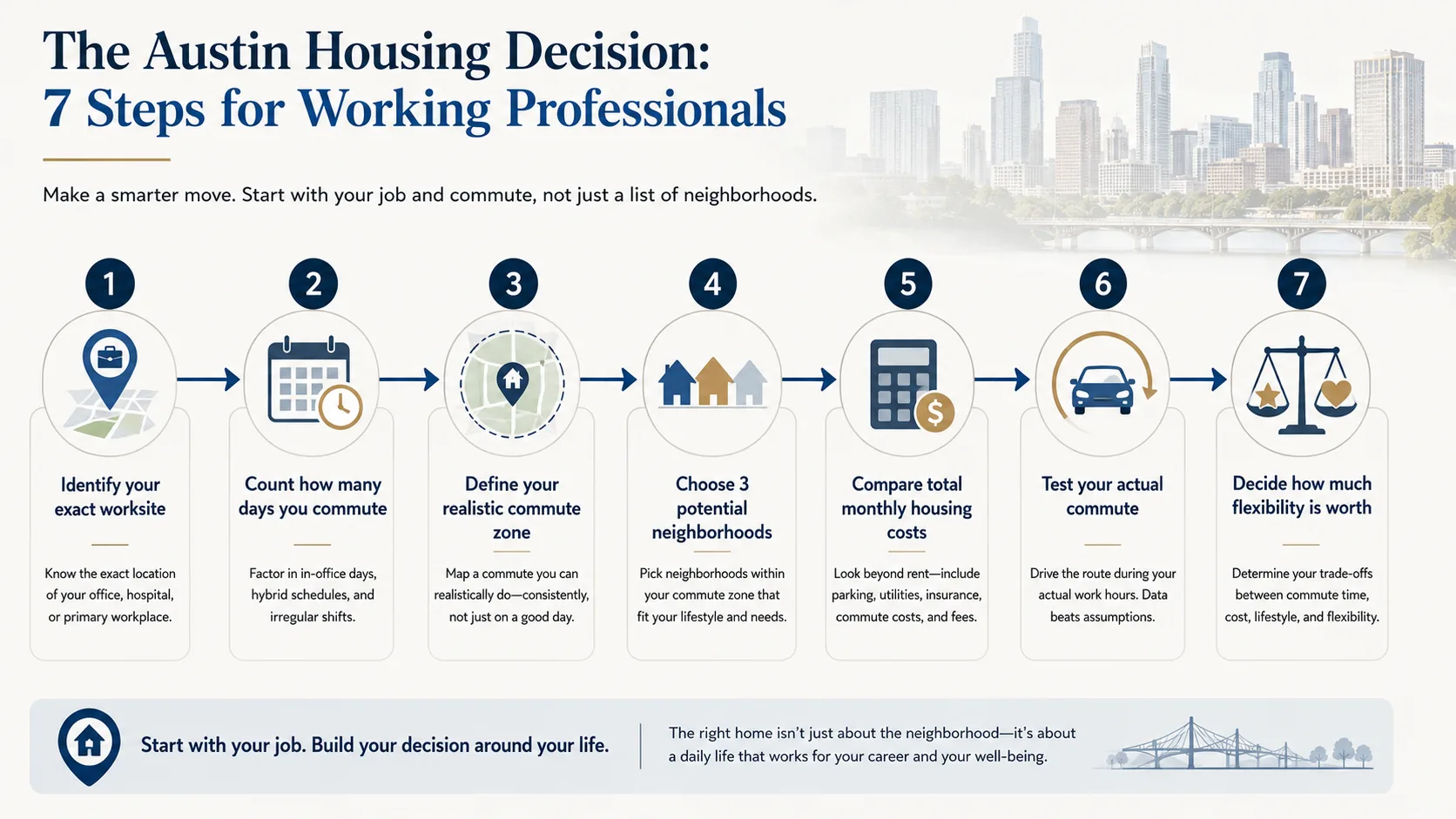
- Identify the exact worksite: The campus, hospital, office or plant, not just the employer.
- Count your commute days: Five days a week and two days a month are different problems.
- Define a realistic commute zone: Around the worksite before you browse listings.
- Shortlist three neighborhoods: One close to work, one lifestyle-led, one value-oriented.
- Compare total monthly cost: Rent, parking, tolls, fuel, utilities, internet and mandatory fees.
- Drive the route at peak hours: Off-peak drives are misleading in Austin.
- Decide what flexibility is worth: A short first lease is rational in an unfamiliar city.
The Mistakes We See Most
- Choosing the neighborhood before the workplace.
- Assuming every tech job is at The Domain.
- Picking the cheapest rent without counting transport and time.
- Ignoring parking until it appears as a separate charge.
- Treating hybrid work as no commute.
- Taking a big suburban home when most of your week is still central.
- Signing a long lease after a weekend visit or a listing photo. If you are booking sight unseen, read how to avoid rental scams in Texas first.
Frequently Asked Questions
What are the best areas to live in Austin for working professionals?
It depends on where you work. Downtown suits central corporate and government roles, North Burnet and The Domain suit North Austin offices, Round Rock suits Dell and other north-side employers, and central neighborhoods like Hyde Park and Mueller suit many healthcare workers. Start with your worksite, then choose.
Where should healthcare professionals live in Austin?
Start with the hospital. Staff at central hospitals near UT and West 38th Street can look at Hyde Park, North University, North Loop and Mueller. Staff at North Austin facilities such as Ascension Seton Northwest are better served by North Austin neighborhoods. Shift work makes a short commute especially valuable.
Should I live downtown if I work downtown in Austin?
It is a sensible starting point, especially if you want to walk and drive less. Compare rent, parking and lifestyle costs before deciding, because downtown parking is rarely included in rent and is often the cost that changes the math.
Where should remote workers live in Austin?
Remote workers can weigh lifestyle more heavily, so areas like Mueller, East Austin, South Lamar and North Loop are popular starting points. The main trap is paying extra to live near an office you only visit a couple of times a month.
Do I need a car if I work in Austin?
It depends on where you live and work. Central Austin supports living with little or no driving, and the CapMetro Red Line links downtown with North Austin and Leander. Most suburban job corridors are much easier with a car.
How long should I stay in furnished housing before choosing a neighborhood?
There is no fixed rule, but 30 to 90 days is usually enough to experience the real commute, your neighborhood routine and your actual monthly costs before committing to a longer lease.
Choose the Home Base That Fits Your Working Life
There is no single best neighborhood in Austin for working professionals. A downtown consultant, a Dell engineer and a night-shift nurse should all reach different answers. The order that works: worksite, then commute, then neighborhood, then housing, then the long-term decision.
When you are new to the city and still working out both, flexibility has real value. Compare the same logic in another Texas metro in our Houston neighborhood guide.
Ready to find your Austin home base? → Browse furnished Austin homes with Sandpiper Homes
Looking for a furnished place?
Browse move-in-ready monthly rentals on Sandpiper.